
DBT and Seasonal Depression: Why Emotion Regulation Skills Outlast the Light Box
DBT emotion regulation skills for seasonal depression in Saskatchewan — what the research supports, what it doesn’t, and how to build a winter plan that holds.
DBT foundations
DBT helps you understand your experiences while practising ways to respond differently. Treatment brings acceptance and change together, with clear priorities and skills you can use in everyday life.
Educational information to support understanding and discussion with your clinician.
Understand your experience and reduce judgement.
Practise skills and work towards responses that help.
Start with the ideas that relate to your experience. You can bring questions to your clinician.
Notice reality, validate what makes sense, reduce judgement and make room for the present moment.
Learn skills, alter behaviour, solve problems and move toward goals that matter.
Start with safety and behaviours that threaten life.
Address barriers on either side of the therapeutic relationship.
Work on patterns that disrupt relationships, health, work, and daily living.
Build capabilities throughout treatment while moving towards meaningful goals.
These are Stage 1 treatment priorities. Skills are taught and practised throughout; life-building is not a promise of a fixed or linear recovery sequence.
FROM DIARY ENTRIES TO A SHARED PLAN
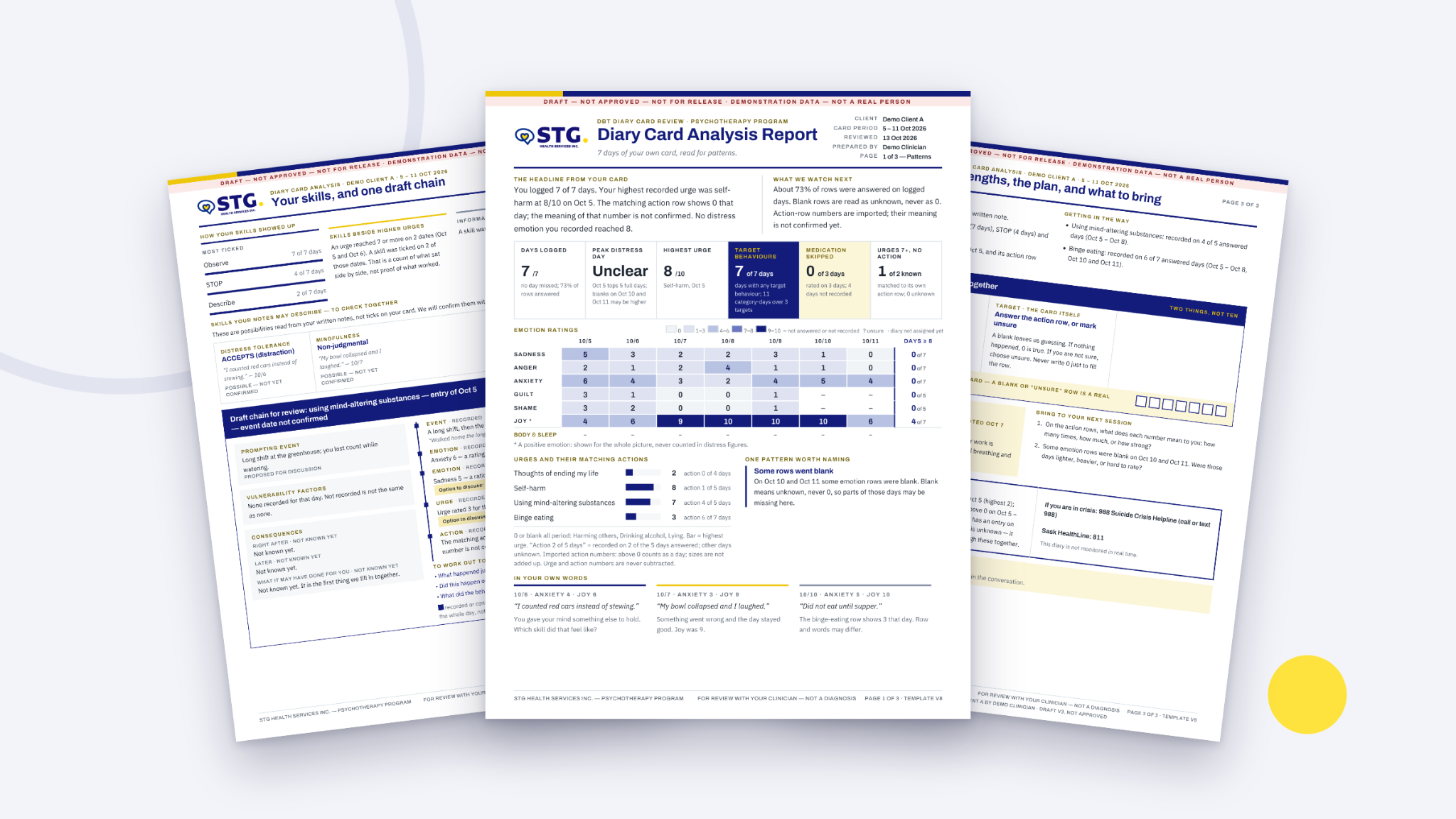
A diary card captures moments that can be difficult to remember in an appointment. A report organizes those entries into an overview you and your clinician can discuss.
Look at emotions, urges, actions, and relevant events together. Missing entries remain gaps in information; they are not treated as zero ratings.
Notice the skills described in your words, including efforts that may be easy to overlook. Any interpretation is checked against your experience.
Bring the observations into the next session, explore what may be contributing, and agree on a manageable practice plan.
A report supports clinical conversation. It does not diagnose a condition, establish why something happened, or replace assessment and your wider treatment plan.
Fictional Diary Card Analysis Report · patterns, skills and next steps
All entries, values, and observations in this public example are invented. The example shows the format, not a promised outcome.
Your clinician will explain whether reports are included in your program, how diary cards are submitted, and when they are reviewed. Submissions are not continuously monitored or an emergency contact channel. Follow your agreed safety plan and use urgent support when needed.
Choose a small exercise that fits the current situation. Stop and seek clinical or emergency support when risk, dissociation, mania, psychosis, intoxication, or medical concerns make self-directed practice unsafe.
YOUR QUESTIONS
No. DBT methods are used across several problems, but treatment should still be matched to the target pattern and evidence.
No. Skills training is one mode. Comprehensive DBT also includes individual therapy, coaching, and therapist consultation.
No. Validation communicates that an experience or response makes sense in context; it does not require approving every behaviour.
It depends on the pathway. A full skills cycle is 24 weeks; comprehensive treatment commonly requires longer.

DBT emotion regulation skills for seasonal depression in Saskatchewan — what the research supports, what it doesn’t, and how to build a winter plan that holds.
A clinician can help determine whether this concept fits the actual pattern and which treatment option fits your needs.