DBT care matched to the level of support you actually need.
Individual therapy, skills training, comprehensive DBT, and specialized pathways delivered securely online across Alberta.
You do not need a confirmed diagnosis or a perfect explanation before reaching out. Start with what has been difficult; we help determine which DBT structure—or another service—fits best.
Clinician-reviewed intake · Individual and group options · Online across Alberta
You do not need to choose the program first.
A clinician reviews your goals, safety, treatment history, daily functioning, and the amount of structure that may be useful. The recommendation comes after that review—not from an online score.
Skills foundation
DBT Skills Training or Emotional Relief
Personalized weekly work
Individual DBT
Flexible entry
Guided Self-Help when clinically appropriate
Coordinated full model
Comprehensive DBT
After previous DBT
Refresher Plus or DBT Next Steps
DBT is easier to understand when we start with what keeps happening.
These are common reasons people look for DBT support. They are not a diagnostic checklist.
Emotions escalate quickly
You can know what would help and still lose access to it when intensity rises.
Relationships become hard to steady
Conflict, reassurance-seeking, withdrawal, anger, or fear of disconnection can take over.
Coping helps briefly—and costs later
An urge or familiar behaviour may bring short-term relief while creating longer-term consequences.
Therapy makes sense in session but not in the moment
You may understand the ideas and still need more structured practice between appointments.
The right DBT format depends on the problem you are trying to solve.
Some people need skills teaching. Some need individualized behavioural treatment. Some need the coordinated comprehensive model. Specialized pathways are considered when they fit the clinical picture.
Flexible starting point
Guided Self-Help can provide structured learning with clinician guidance when a lower-intensity format fits.
Build a skills foundation
Skills Training and Emotional Relief focus on learning and applying practical DBT skills.
Personalize the work
Individual DBT focuses on your behavioural patterns, treatment targets, and real-life situations.
Coordinate the full model
Comprehensive DBT combines individual therapy, skills training, coaching, and therapist consultation.
Specialized or next-phase care
DBT-PE, RO-DBT, Refresher Plus, and Next Steps address specific indications or later treatment goals.
Comprehensive DBT is a coordinated treatment model—not simply a skills group.
When the full model is recommended, four treatment functions work together around a shared plan.
Individual DBT
Personalized behavioural treatment and treatment priorities.
Skills training
Systematic practice in mindfulness, distress tolerance, emotion regulation, and interpersonal effectiveness.
Between-session coaching
Brief skills coaching within agreed boundaries when included in the treatment plan.
Therapist consultation team
A clinician-facing structure that supports treatment quality and adherence.
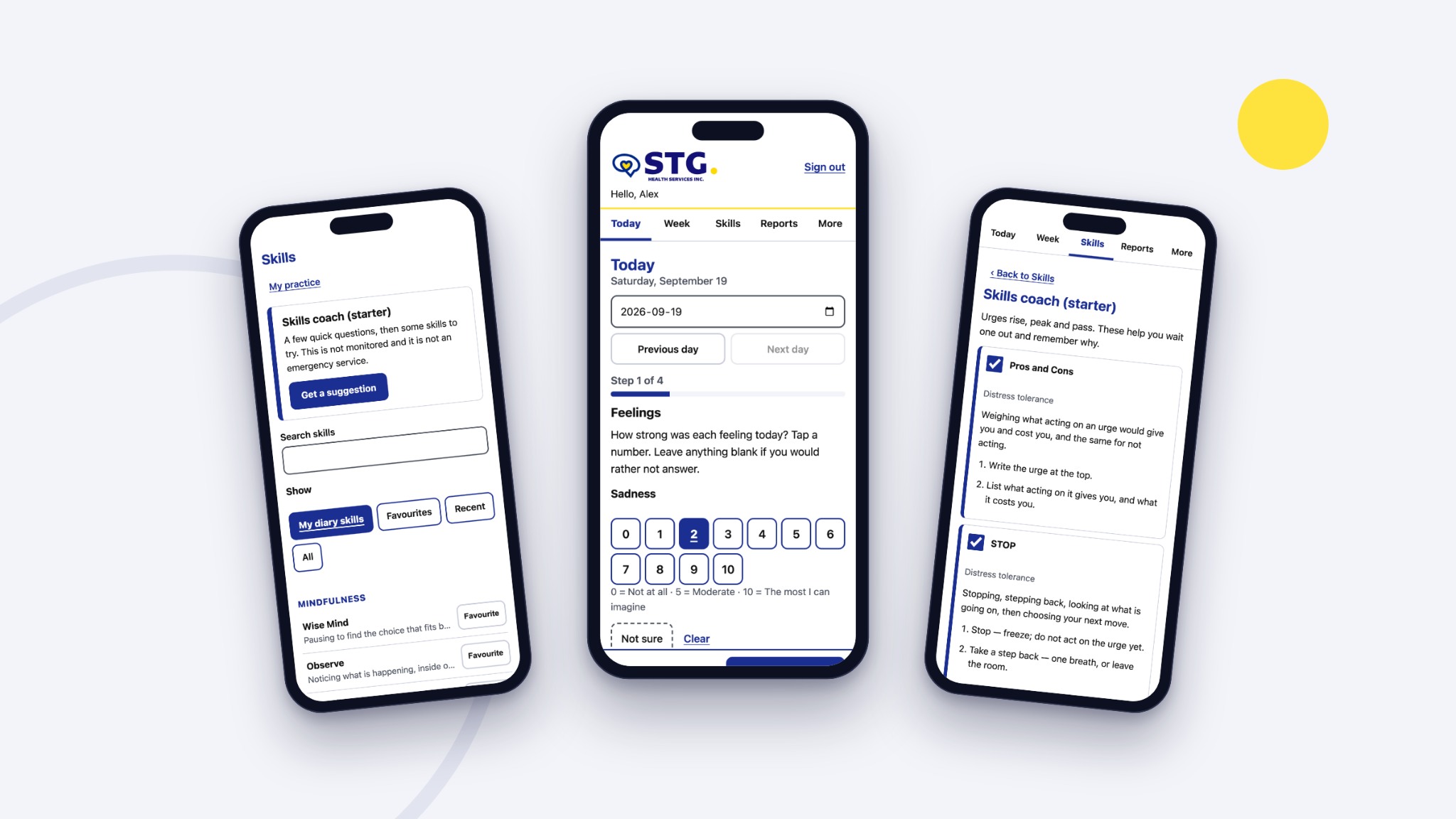
Your week becomes part of the clinical conversation.
The STG Diary Card System connects brief daily check-ins, skills practice, clinician review, and plain-language reports. It is designed to help treatment work with what happened between sessions—not only what can be remembered in the room.
DBT can be adapted to different clinical patterns without pretending every problem is the same.
BPD & relationship patterns
Structured DBT can target emotion dysregulation, self-harm, impulsivity, and relationship instability.
Bipolar-related coping
DBT skills can support coping, routines, and relationships alongside appropriate medical assessment and treatment.
Trauma & DBT-PE
Trauma-focused exposure may be considered after sufficient stabilization and readiness.
Adolescents & families
Youth, caregiver, and family work can be coordinated around emotion regulation, communication, and safety.
Overcontrol & RO-DBT
RO-DBT targets patterns such as excessive inhibition, rigidity, social signalling difficulties, and emotional loneliness.
Addiction recovery
DBT methods can support urge management, relapse-chain analysis, emotion regulation, and recovery-oriented behaviour.
Warm, structured care with a real clinician alongside you.
DBT Alberta is an STG Health service. Clinician assignment depends on scope, clinical fit, availability, insurance or funding requirements, and the treatment pathway.

Dr. Chris de Feijter
Clinical Counsellor / Psychotherapist
EdD., MACP.

Mattea Koebernick
Mental Health Therapist
BA (PSYCH), MACP.
A clear next step without having to solve the whole treatment plan yourself.
Tell us what is happening
Complete the secure intake with your concerns, goals, safety information, and practical needs.
A clinician reviews the fit
We consider the pattern, treatment history, functioning, risks, and the amount of structure that may be useful.
Review the recommendation
We explain the suggested service, clinician, fees, coverage questions, and what happens next.